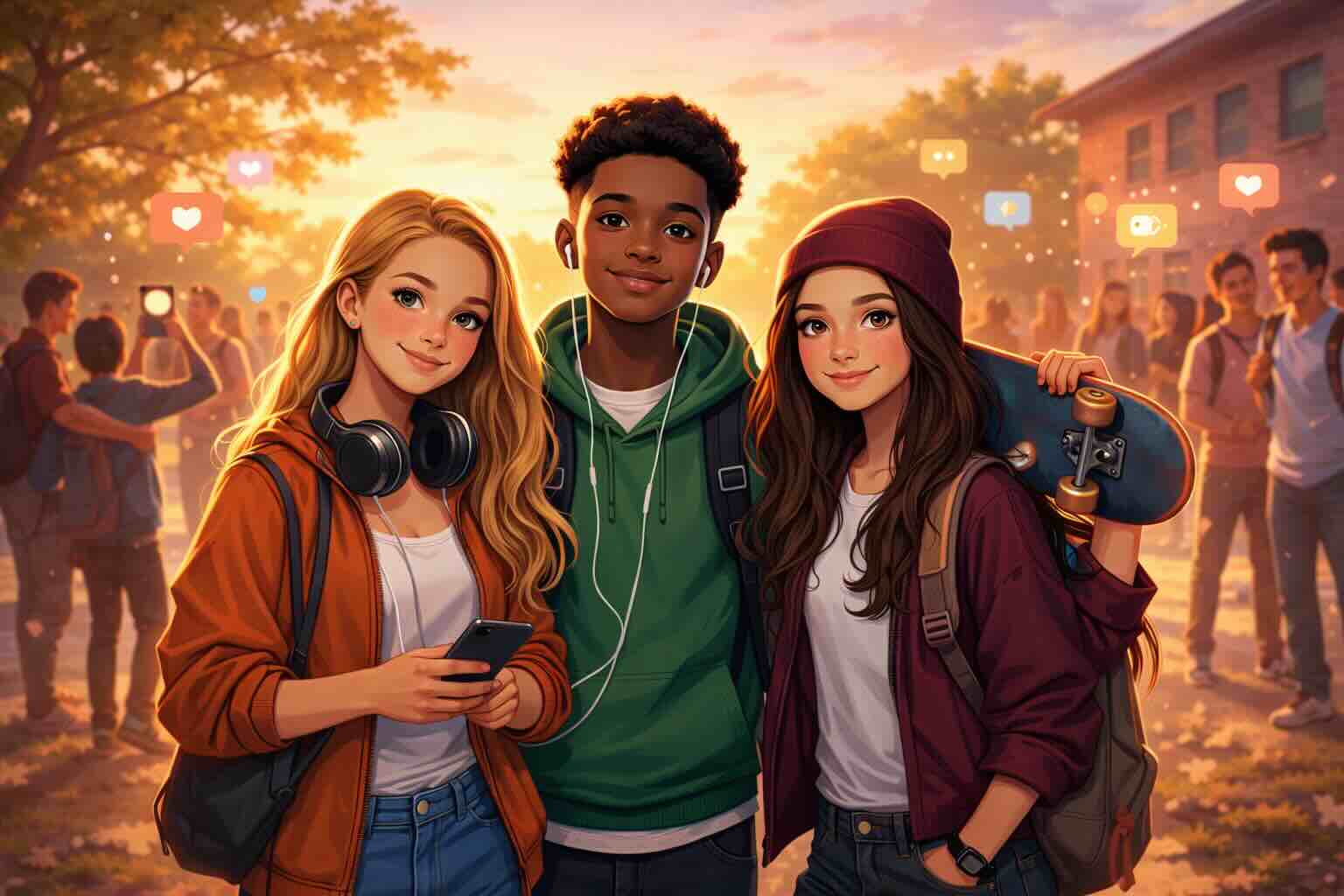
Growing Up Between Two Worlds
Adolescence has always been a time of turbulence. It is the bridge between childhood and adulthood, between dependence and autonomy, between “Who am I?” and “Who will I become?” But in the 21st century, this bridge is suspended over a landscape that previous generations could hardly have imagined.
Today’s adolescents are not simply growing up. They are growing up in a world that changes faster than their nervous systems were designed to process.
A Brain Under Construction in a Hyperstimulated World
Neuroscience tells us that the adolescent brain is still developing, particularly the prefrontal cortex — the region responsible for impulse control, planning, and long-term decision-making. At the same time, the emotional and reward systems are highly active. This means that adolescents feel intensely, react quickly, and are wired to seek novelty and belonging.
Now place that developing brain in a digital ecosystem of constant notifications, endless comparison, instant feedback, and algorithm-driven stimulation. The result is not weakness or fragility. It is a nervous system under unprecedented demand.
In previous generations, social comparison was limited to classmates or neighbours. Today, comparison is global. A teenager no longer measures themselves against 20 peers, but against millions of curated, filtered, and often unrealistic representations of success, beauty, and happiness.
Identity in the Age of Visibility
Adolescence has always been about identity formation. But identity used to unfold gradually, through experimentation within relatively stable communities. Now identity is performed publicly — often online — and recorded permanently.
Young people are asked to define themselves earlier and more explicitly:
What do you believe?
What do you look like?
Who do you love?
What do you stand for?
Exploration, which used to be fluid and private, now often happens under the gaze of an audience. Mistakes can become screenshots. Vulnerability can become content.
Yet, at the same time, the digital world offers something powerful: connection. Teenagers can find communities that understand them, especially if they feel different, marginalised, or isolated in their immediate environment. A young person questioning their identity in a small town can now connect with others across the globe. This is not a minor shift. It can be life-saving.
Pressure Without Pause
The 21st century adolescent lives in a culture of performance. Academic expectations are high. Career paths feel uncertain. The future appears unstable — economically, politically, environmentally.
Many teenagers carry a quiet anxiety about climate change, global conflict, and technological disruption. They are aware that the world they inherit is complex and fragile. Unlike previous generations, they cannot easily ignore this awareness. It is streamed into their devices daily.
There is also less psychological “downtime.” Boredom — once a natural part of development and a fertile ground for creativity — has become rare. Silence is often replaced by scrolling. Rest is replaced by digital engagement.
The nervous system does not always know how to distinguish between real threat and digital intensity. Continuous stimulation can contribute to sleep difficulties, attention problems, irritability, and emotional exhaustion.
Mental Health: Fragility or Sensitivity?
Statistics show rising levels of anxiety, depression, and self-harm among adolescents in many countries. But we must be careful not to label an entire generation as fragile.
Today’s teenagers are also more emotionally literate than previous generations. They speak openly about mental health. They question stigma. They seek therapy more readily. What may look like increased vulnerability may also reflect increased awareness.
They are sensitive — and sensitivity is not pathology. Sensitivity is often the capacity to perceive complexity.
Autonomy in a Connected World
Paradoxically, adolescents today may have more digital freedom but less physical autonomy. Many spend less time outdoors, less time navigating cities alone, less time engaging in unstructured peer interaction.
Risk-taking, a natural part of adolescence, has shifted arenas. Instead of climbing trees or cycling miles away from home, risks may occur online — through social exposure, digital conflict, or impulsive posting.
The developmental task remains the same: to separate from parents psychologically while maintaining connection. But that separation now happens in a world where parents may monitor location apps, follow social media accounts, and remain digitally present at all times.
What Do Adolescents Need Today?
Despite technological and cultural shifts, the core psychological needs of adolescents have not changed:
- To belong
- To be seen
- To feel competent
- To explore safely
- To be understood without being controlled
They need adults who can tolerate their intensity without panicking.
They need boundaries that are firm but not humiliating.
They need conversations, not surveillance.
They need spaces where they are not performing.
A Generation Between Anxiety and Possibility
It is easy to focus only on the risks of growing up in the 21st century. But this generation is also adaptive, creative, and socially aware. They navigate diversity with greater fluency. They question injustice earlier. They are technologically competent in ways that will shape future innovation.
Adolescence has never been simple. But perhaps today it requires more intentional support than ever before — from families, schools, communities, and policymakers.
Growing up has always meant standing between two worlds. In the 21st century, that space is louder, faster, and more visible. Yet the essential task remains beautifully human:
To become oneself.
And that task, despite everything, is still possible.
Comments are closed