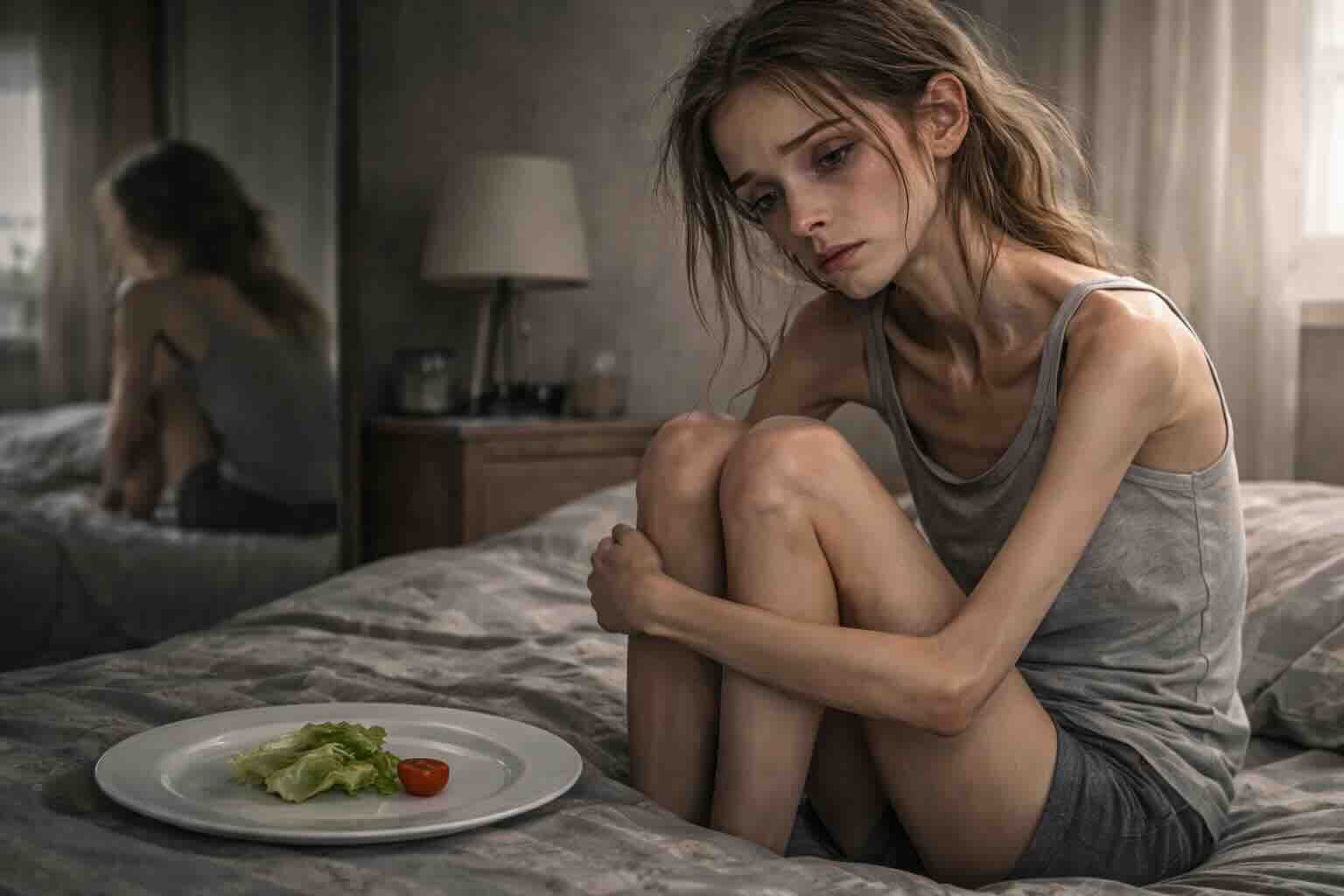
When the Mirror Becomes the Enemy
Anorexia is often misunderstood as a disorder about weight. But at its psychological core, it is a disorder about perception, identity, and control. And central to it all is body image — the deeply personal, often painful relationship someone has with their own reflection.
To understand anorexia, we must look beyond the scale and into the mirror.
What Is Body Image?
Body image is not simply how we look. It is how we experience how we look. It includes:
- Thoughts about the body (“I am too big.”)
- Feelings toward the body (shame, disgust, pride, fear)
- Behaviours related to the body (checking, avoiding mirrors, restricting food)
- The degree to which body shape defines self-worth
In anorexia, body image becomes distorted — but not in a cartoonish or delusional way. The distortion is subtle and persistent. A person may be medically underweight yet genuinely experience parts of their body as “too large.”
This is not vanity. It is a perceptual and emotional misalignment.
The Illusion of Control
Many people with anorexia describe a powerful fear of weight gain. But beneath that fear often lies something deeper: fear of losing control.
Food restriction can create a temporary sense of mastery. Hunger becomes something to conquer. The body becomes a project to perfect.
In a world that feels unpredictable — emotionally, relationally, socially — controlling food intake can feel stabilising.
The body becomes the battlefield where anxiety is managed.
When Self-Worth Shrinks to Size
In anorexia, body image becomes tightly fused with identity. Self-esteem may rise and fall according to:
- The number on the scale
- The fit of clothes
- The perceived visibility of bones
- The comparison with others
This narrowing of identity is psychologically devastating. A complex human being becomes reduced to shape and weight.
And yet, even at very low weights, the internal critic rarely quiets. The goalposts move. The body is never “good enough.”
The Cultural Mirror
We cannot discuss body image without acknowledging culture.
Modern media promotes unrealistic standards of thinness and perfection. Social media amplifies comparison. Filters smooth skin, narrow waists, sharpen jawlines. Algorithms reward appearance-based validation.
Young people grow up in an environment where the body is constantly evaluated — by others and by themselves.
For someone vulnerable to perfectionism or anxiety, this cultural pressure can intensify self-scrutiny.
But anorexia is not caused by media alone. Many people are exposed to unrealistic ideals and do not develop eating disorders. Anorexia usually emerges from a combination of factors:
- Temperament (perfectionism, high sensitivity)
- Family dynamics
- Trauma or emotional invalidation
- Difficulty regulating intense emotions
- Societal pressure
Body image becomes the visible symptom of a much deeper struggle.
The Body as an Emotional Container
For many individuals with anorexia, the body holds unprocessed emotion.
Shame may be experienced as “fatness.”
Anger may be redirected into self-criticism.
Grief may be numbed through restriction.
Restricting food can dull emotional intensity. Starvation alters brain chemistry, sometimes creating a temporary sense of clarity or emotional blunting. But this comes at enormous psychological and physical cost.
Over time, starvation amplifies anxiety, rigidity, and obsessive thinking — strengthening the disorder’s grip.
The Paradox of Visibility
Ironically, people with anorexia often feel intensely visible and invisible at the same time.
They may crave reassurance, yet reject it.
They may long to be seen for who they are, yet fear being truly known.
The body becomes both a shield and a signal — a way to express distress without words.
Healing Body Image
Recovery is not simply about weight restoration. It involves reshaping the relationship with the body.
This may include:
- Relearning hunger and fullness cues
- Challenging distorted thoughts
- Exploring emotional regulation
- Building identity beyond appearance
- Addressing trauma when present
- Reconnecting with the body through safe, embodied practices
Healing body image takes time. The mirror does not become kind overnight. But slowly, perception can become more aligned with reality.
Most importantly, the body can shift from being an enemy to being a home.
A Broader Understanding
Anorexia is not about superficial beauty standards. It is about fear, control, and the desperate attempt to feel safe inside one’s own skin.
Body image distortion is both symptom and metaphor — a sign that something deeper needs care.
When we move beyond judgement and toward understanding, we make space for recovery. And recovery, at its heart, is not about achieving a perfect body.
It is about reclaiming a full life.
Comments are closed