Before the Word, Not Before the Experience
The word “stress” did not exist in the 15th century in the way we use it today. There were no cortisol measurements, no psychiatric classifications, no workplace burnout seminars. And yet, human beings in the 1400s were not immune to psychological strain.
They lived in a world marked by uncertainty, hierarchy, disease and divine interpretation. Stress was not medicalised. It was moralised, spiritualised and normalised.
But it was very much present.
A Life of Instability
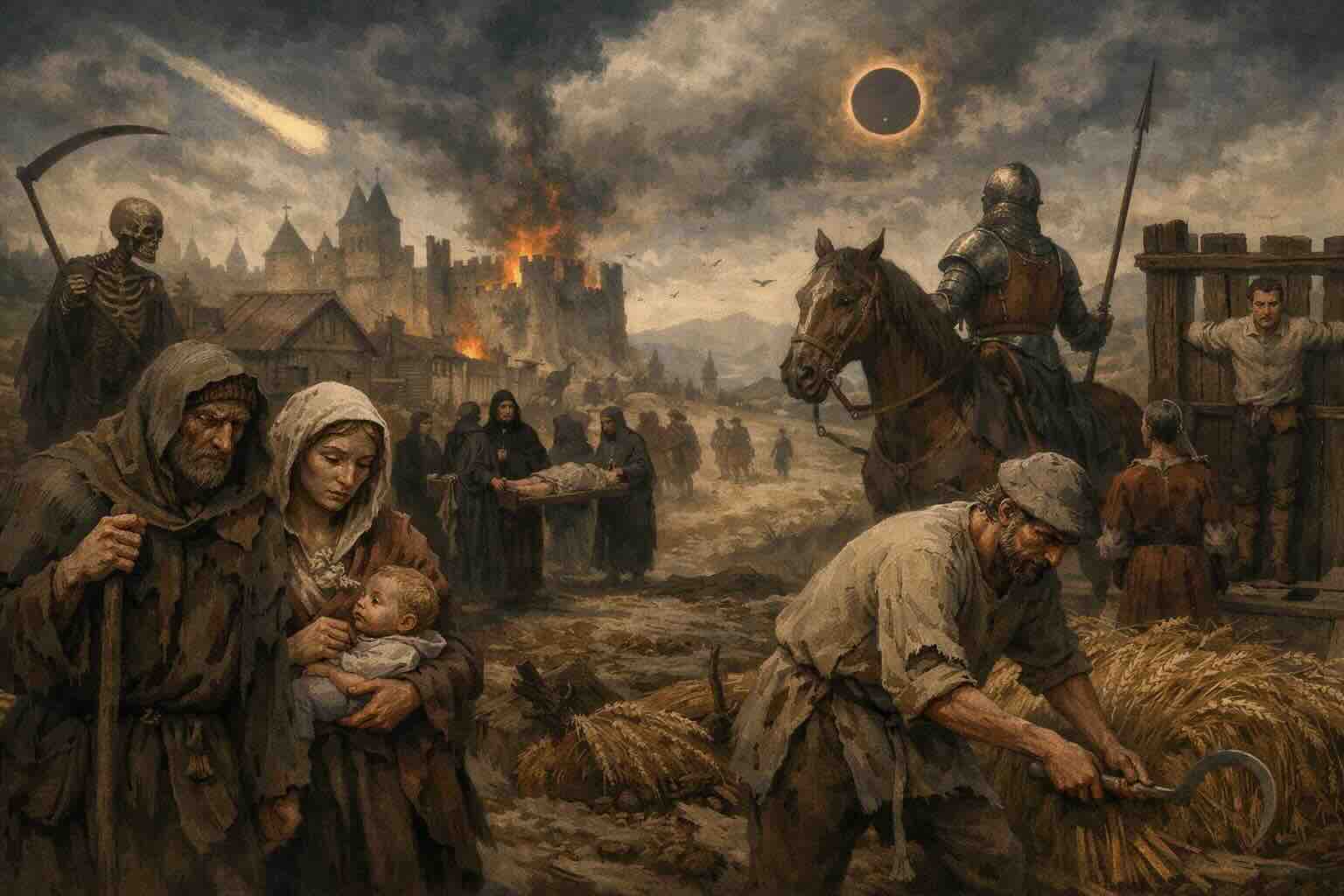
The 15th century was a period of profound transition. In Europe, it was the late Middle Ages, edging toward the Renaissance. Political power shifted frequently. Wars were common. Travel was dangerous. Food supply was unstable. Epidemics were still fresh in collective memory after the devastation of the Black Death.
Life expectancy was shorter. Infant mortality was high. Illness had few effective treatments. A simple infection could be fatal.
Uncertainty was not episodic. It was structural.
Under such conditions, chronic vigilance was adaptive. But it was also exhausting.
Fear as a Daily Companion
Fear in the 15th century had a different texture from modern anxiety. It was less abstract and more immediate.
Fear of famine.
Fear of plague.
Fear of invasion.
Fear of divine punishment.
Religion played a central role in interpreting distress. Suffering was often understood through spiritual frameworks—sin, trial, fate, providence.
Existential anxiety was not secular; it was theological.
Social Hierarchy and Powerlessness
Medieval societies were rigidly hierarchical. Most people had little control over their social position. Feudal structures limited mobility. Serfs worked land they did not own. Guild systems regulated trades. Women’s autonomy was restricted.
Powerlessness generates stress. When agency is limited and survival depends on obedience to authority—lords, clergy, monarchs—the nervous system adapts to constraint.
Open protest was dangerous. Emotional expression was often governed by social norms.
Stress did not disappear. It compressed.
Labour and Physical Strain
For the majority of the population, life involved physically demanding labour. Farming, craft production and manual work dominated daily routines. Work was tied to natural cycles—sunlight, seasons, weather.
The stress was bodily as much as psychological.
Unlike modern cognitive overload, 15th-century stress often manifested through physical exhaustion, hunger and environmental hardship.
Yet mental strain accompanied it—concerns about harvest failure, taxation, war conscription.
Communal Containment
One difference from modern stress culture lies in communal integration. Life was rarely solitary. Extended families, villages and religious communities provided collective identity.
Ritual, prayer and shared belief systems structured experience. Public ceremonies marked transitions—birth, marriage, death.
These communal frameworks offered psychological containment. Suffering was rarely private in the modern sense. It was interpreted collectively.
Belonging softened individual isolation.
Emotional Expression and Melancholy
The 15th century recognised states of “melancholy.” Influenced by humoral theory, emotional disturbances were understood as imbalances in bodily fluids rather than cognitive distortions.
Melancholy was sometimes associated with intellectual depth, sometimes with illness.
Although conceptualised differently, emotional suffering was acknowledged. Art and literature from the period reveal themes of longing, loss and existential reflection.
Stress did not lack language; it had a different language.
Transition and Transformation
The 15th century was also an era of change. The printing press emerged. Exploration expanded geographic horizons. Renaissance humanism began reshaping intellectual life.
Periods of transformation generate psychological strain. Old structures loosen before new ones stabilise.
In this sense, stress during the 15th century resembles modern stress: the tension between continuity and disruption.
Then and Now
What distinguishes 15th-century stress from contemporary stress is not intensity, but structure. Today, many stressors are abstract—economic markets, digital reputations, future projections. In the 15th century, stress was more immediate and embodied.
Yet the nervous system responding to threat was the same.
The heart accelerated. The mind anticipated loss. The body prepared for danger.
Human physiology has not changed as rapidly as human culture.
The Continuity of Strain
Stress is not a modern invention. It is a human response to uncertainty, threat and limited control. What shifts across centuries is context and interpretation.
In the 15th century, stress was woven into survival, faith and hierarchy. It was endured within communal structures and explained through spiritual frameworks.
Today, stress is medicalised, individualised and often privatised.
But across centuries, one truth remains constant: human beings have always carried tension between fragility and endurance.
The forms change. The nervous system remains.
Comments are closed