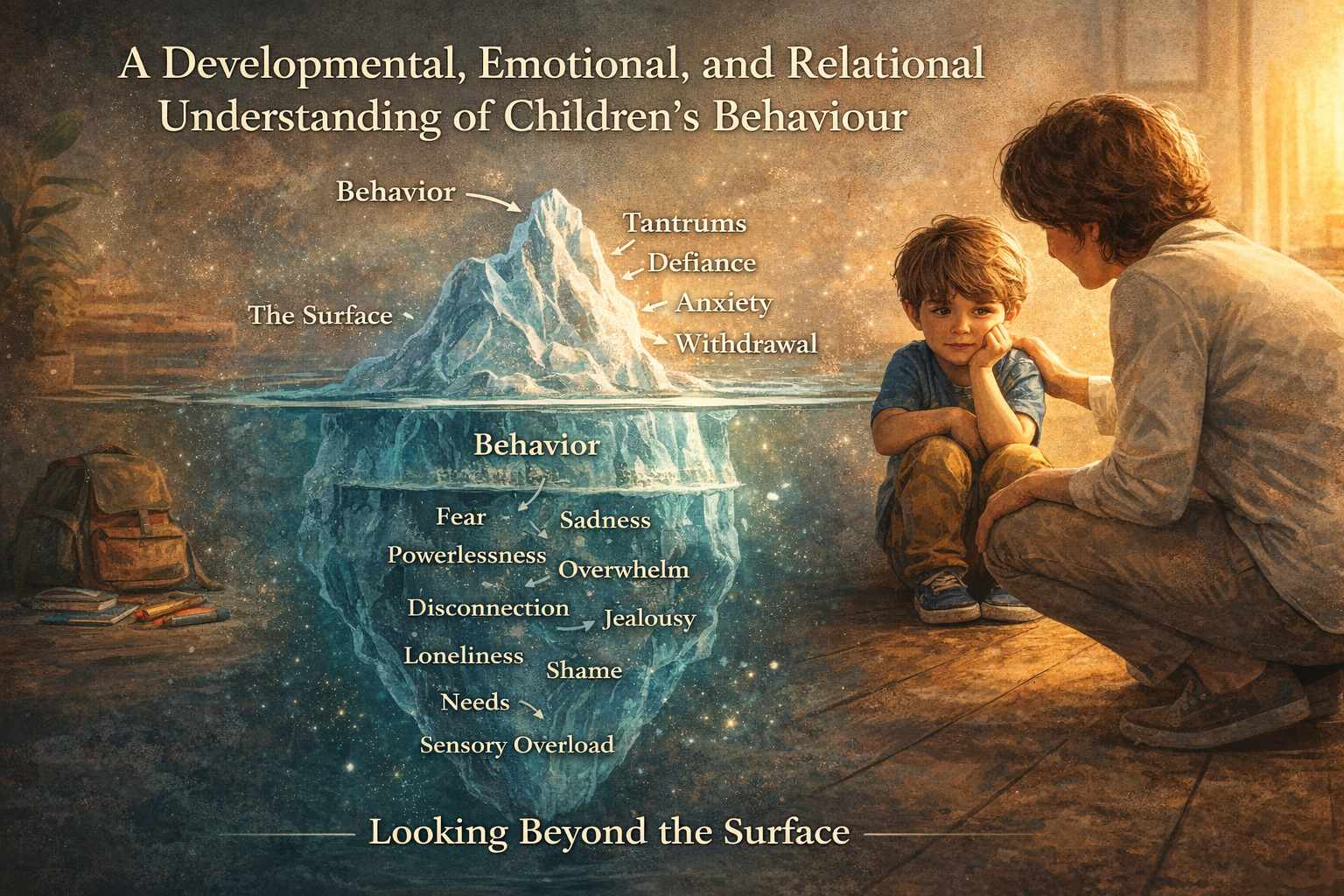
A developmental, emotional, and relational understanding of children’s behaviour
Looking Beyond the Surface
Few experiences in parenting are as emotionally charged as dealing with a child’s difficult behaviour. Parents often arrive in therapy or consultations carrying a mixture of exhaustion, guilt, confusion, and sometimes quiet shame. They describe tantrums that seem endless, defiance that feels personal, anxiety that limits daily life, or emotional reactions that appear disproportionate and unpredictable. In these moments, the behaviour itself easily becomes the focus — the visible, disruptive, undeniable fact that demands attention.
Yet one of the most transformative shifts in understanding children is the realization that behaviour is rarely the core problem. Rather, behaviour is the most accessible expression of something happening at a deeper level. It is not simply a set of actions to be corrected, but a form of communication. Children, especially in the early and middle years, do not yet possess the emotional vocabulary, reflective capacity, or neurological maturity that allow adults to describe their internal experiences in words. When overwhelmed, confused, frightened, ashamed, lonely, or overstimulated, they cannot say, “I am emotionally dysregulated,” or “I feel insecure in this situation.” Instead, they show us.
This perspective does not romanticize behaviour or remove the need for limits. It does, however, reposition parents from the role of behaviour managers to that of emotional interpreters. And this shift changes everything — not only for the child, but for the emotional climate of the family as a whole.
The Developmental Reality Behind Behaviour
To understand why behaviour functions as communication, we must first consider how children develop. The human brain does not mature all at once. The areas responsible for reasoning, impulse control, planning, and emotional regulation — primarily located in the prefrontal cortex — are among the last to fully develop, continuing to mature into early adulthood. In contrast, the emotional centers of the brain, including structures involved in fear, arousal, and survival responses, are active from very early in life.
This developmental imbalance means that children often experience strong emotions without having the neurological equipment to manage them. When a child is overtired, overstimulated, disappointed, excluded, or anxious, the emotional brain can become activated quickly and intensely. In such states, logical explanations, moral reasoning, and demands for self-control are often ineffective, not because the child is unwilling, but because they are temporarily unable.
A tantrum, then, may be less an act of willful disobedience and more an expression of emotional flooding. Aggressive behaviour may reflect a sense of powerlessness. Withdrawal may hide shame or sadness. Avoidance may signal anxiety that feels overwhelming. Seen in this light, behaviour is not a moral failure but a developmental signal.
Behaviour as the Visible Tip of an Invisible Experience
It is helpful to imagine behaviour as the tip of an iceberg. What is visible above the surface — yelling, hitting, crying, refusing, ignoring — is only a small portion of the whole picture. Beneath the surface lie the feelings, needs, and internal struggles that give rise to these actions. These may include fear of separation, a need for connection, sensory overload, jealousy of a sibling, a longing for autonomy, or the aftereffects of a difficult day at school.
When parents focus exclusively on stopping the visible behaviour, they may unintentionally miss the emotional message below. This can lead to repeated cycles of correction and escalation, where the behaviour persists because the underlying experience remains unaddressed. The child, in turn, may feel increasingly misunderstood, which can intensify emotional reactions rather than reduce them. Approaching behaviour with curiosity — asking not only “What did my child do?” but also “What might my child be feeling?” — opens the door to a more attuned response. This shift does not excuse harmful behaviour; it contextualizes it, allowing parents to respond with both limits and understanding.
The Role of the Nervous System
Modern neuroscience provides further insight into why children behave the way they do. Behaviour often reflects the state of the nervous system. When a child perceives threat — whether physical, emotional, or relational — their body may enter a survival mode. In this state, the nervous system prioritizes protection over reflection. Some children respond with fight-like behaviours, such as aggression or yelling. Others move toward flight, avoiding tasks or situations that feel overwhelming. Still others may freeze, appearing shut down or unresponsive. From the outside, these responses can look like stubbornness, laziness, or defiance. From the inside, they are attempts to cope with perceived overwhelm. Recognizing this does not eliminate the need for guidance, but it changes the emotional tone of the parent’s response. Instead of interpreting the child as “being difficult,” the parent can begin to see the child as “having difficulty.”
Emotional Safety as the Foundation for Change
Children develop emotional regulation through co-regulation, a process in which a calmer adult helps an overwhelmed child return to balance. When a parent acknowledges a child’s emotional state — “I see you’re very upset,” or “That was really disappointing” — the child’s nervous system receives signals of safety. This sense of being seen and understood can reduce alarm and make it easier for the child to regain control. Without emotional safety, attempts at discipline can feel threatening, which may further activate the child’s stress response. With emotional safety, even firm limits can be received within the context of connection. The child learns not only what behaviour is acceptable, but also how to move through strong emotions without losing the relationship.
Limits and Understanding as Complementary Forces
A common fear among parents is that focusing on feelings will lead to permissiveness. In reality, emotional understanding and clear boundaries are not opposites; they are partners. Children need structure and limits to feel secure. What changes is the way those limits are delivered. A response such as, “I won’t let you hit, but I can see you’re very angry,” communicates two important messages at once: the behaviour is not acceptable, and the child’s emotional experience is recognized. This dual message helps the child integrate emotional awareness with behavioural control over time.
The Long-Term Impact of Being Understood
When parents consistently approach behaviour as communication, children gradually develop greater emotional literacy. They learn to name feelings, to recognize internal states, and to trust that their emotions can be shared without rejection. Over time, this supports the development of self-regulation, empathy, and resilience. Perhaps most importantly, the child’s sense of self is shaped by these interactions. Instead of internalizing the belief “I am bad,” the child learns, “My feelings make sense, and I can learn to manage them.” This difference can echo throughout development, influencing relationships, self-esteem, and mental health.
From Control to Connection
Seeing behaviour as a message does not make parenting easier in the short term. It requires patience, reflection, and emotional availability. But it does make parenting more meaningful and more aligned with children’s developmental needs. When parents move from trying to control behaviour to trying to understand the child behind the behaviour, they shift from a stance of opposition to one of guidance. In this space, behaviour becomes less of a battle to win and more of a conversation to enter. And in that conversation, children find not only limits, but also the understanding that allows them to grow.
Comments are closed