Why we are overwhelmed — and what our minds and bodies are trying to tell us
Living in a State of Constant Activation
Modern life moves quickly. Messages arrive instantly. Work follows us home through screens. News travels across the world in seconds. Expectations — professional, social, and personal — accumulate quietly but persistently. Even in moments of rest, many people feel mentally “on,” as if something still needs attention.
This state of constant activation has become so normal that many no longer recognize it as stress. Yet the human nervous system was not designed for continuous stimulation. It evolved to respond to threats and then return to calm. Today, the threats are rarely physical, but psychological demands trigger the same biological alarm systems.
Stress is not simply the presence of difficulty. It is the absence of recovery.
The Nervous System Under Pressure
When we experience stress, the body prepares to act. Heart rate increases, muscles tense, attention narrows. In short bursts, this response is adaptive. It helps us meet challenges. But when activation becomes chronic, the body does not fully return to baseline.
Over time, people may experience fatigue, irritability, sleep disturbances, headaches, or difficulty concentrating. Emotionally, there may be anxiety, low mood, or a sense of emptiness. Many describe feeling “wired and tired” — simultaneously exhausted and unable to relax.
This is not a personal failure. It is a biological response to prolonged demand.
The Hidden Stressors of Modern Culture
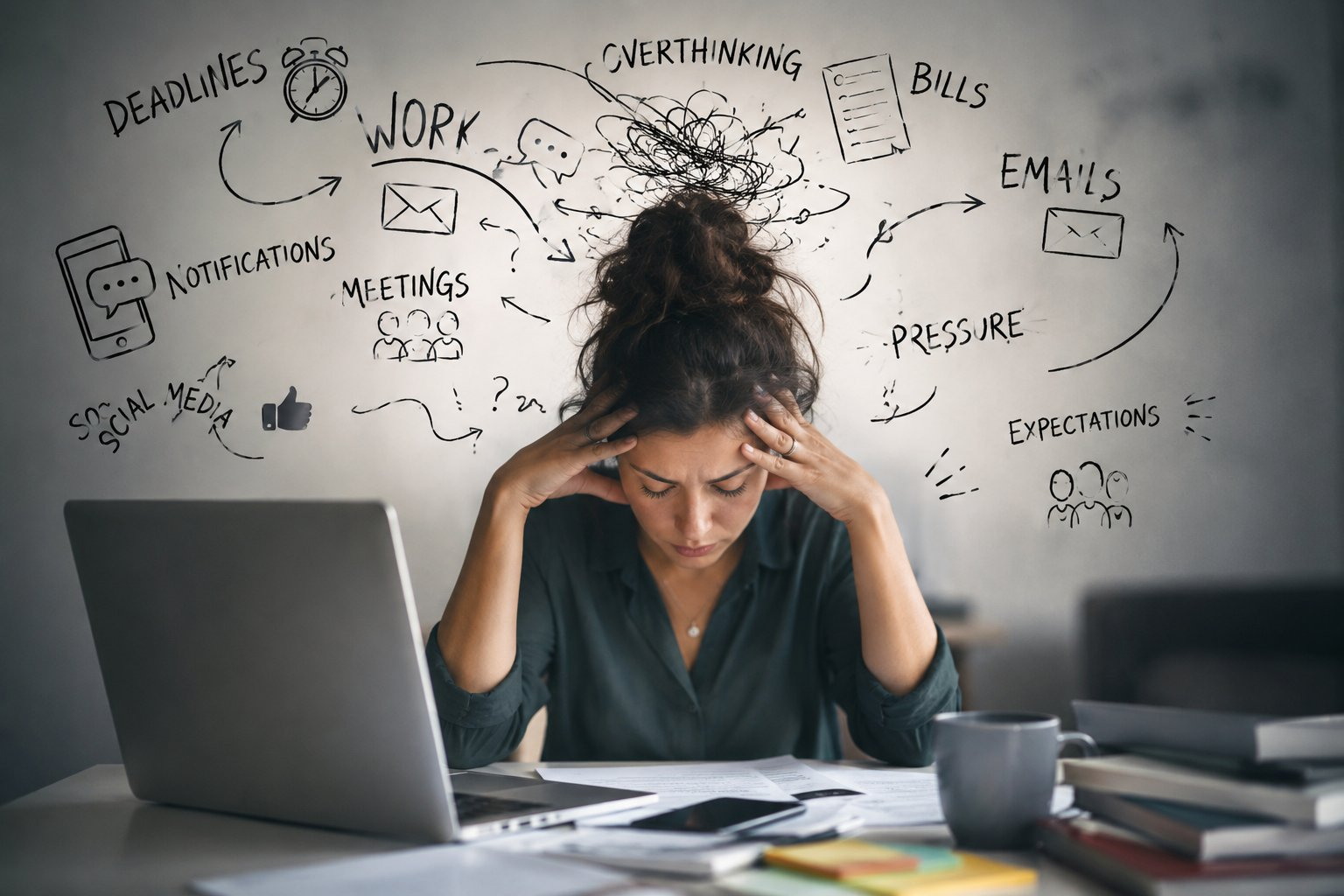
Modern stress does not come only from dramatic events. It accumulates through small, ongoing pressures: comparison on social media, financial uncertainty, information overload, performance expectations, and the feeling of never being finished.
Technology connects us, but it also blurs boundaries. Work and personal life mix. There is less psychological space between roles. The mind rarely experiences true off-time.
This continuous input leaves little room for reflection, boredom, or emotional processing — all of which are essential for mental balance.
Emotional Consequences
Chronic stress affects how we feel and relate to others. Patience decreases. Small frustrations feel larger. Emotional reactions become quicker and sometimes sharper. Relationships can suffer as people have less energy for empathy.
Stress can also numb emotional experience. Some individuals report feeling disconnected, moving through life on autopilot. This emotional flattening is another sign that the system is overwhelmed.
Why Rest Feels Difficult
Many people know they “should” rest, yet find it hard to stop. When the nervous system is used to constant activation, stillness can feel uncomfortable. The mind may continue racing even when the body is still.
Learning to rest again is a gradual process. It involves retraining the nervous system to tolerate calm without interpreting it as unsafe or unproductive.
Small Acts of Regulation
In modern life, stress cannot always be eliminated, but it can be balanced. Moments of physical grounding — slow breathing, walking, stretching — signal safety to the body. Setting boundaries around work and screen time creates psychological space.
Equally important is emotional processing: talking, journaling, or simply allowing feelings to surface rather than pushing them aside.
Recovery does not require dramatic retreats. It often begins with brief pauses throughout the day.
Connection as an Antidote
Humans regulate stress socially. Genuine connection — not performance, but being seen and heard — lowers stress hormones and restores balance. Yet modern busyness often reduces meaningful contact.
Prioritizing relationships is not a luxury; it is a biological need.
Reframing Stress
Stress is not the enemy. It is information. It signals that demands exceed available resources. Listening to this signal allows adjustments. Ignoring it leads to burnout.
When stress is acknowledged rather than denied, people can respond with care rather than self-criticism.
Conclusion
Modern life places continuous demands on a nervous system built for rhythm, not constant intensity. Chronic stress reflects this mismatch. Coping involves creating small spaces for recovery, restoring boundaries, and reconnecting with the body and with others.
The goal is not to remove all pressure, but to allow cycles of activation and rest — the natural pattern of a balanced life.
Comments are closed