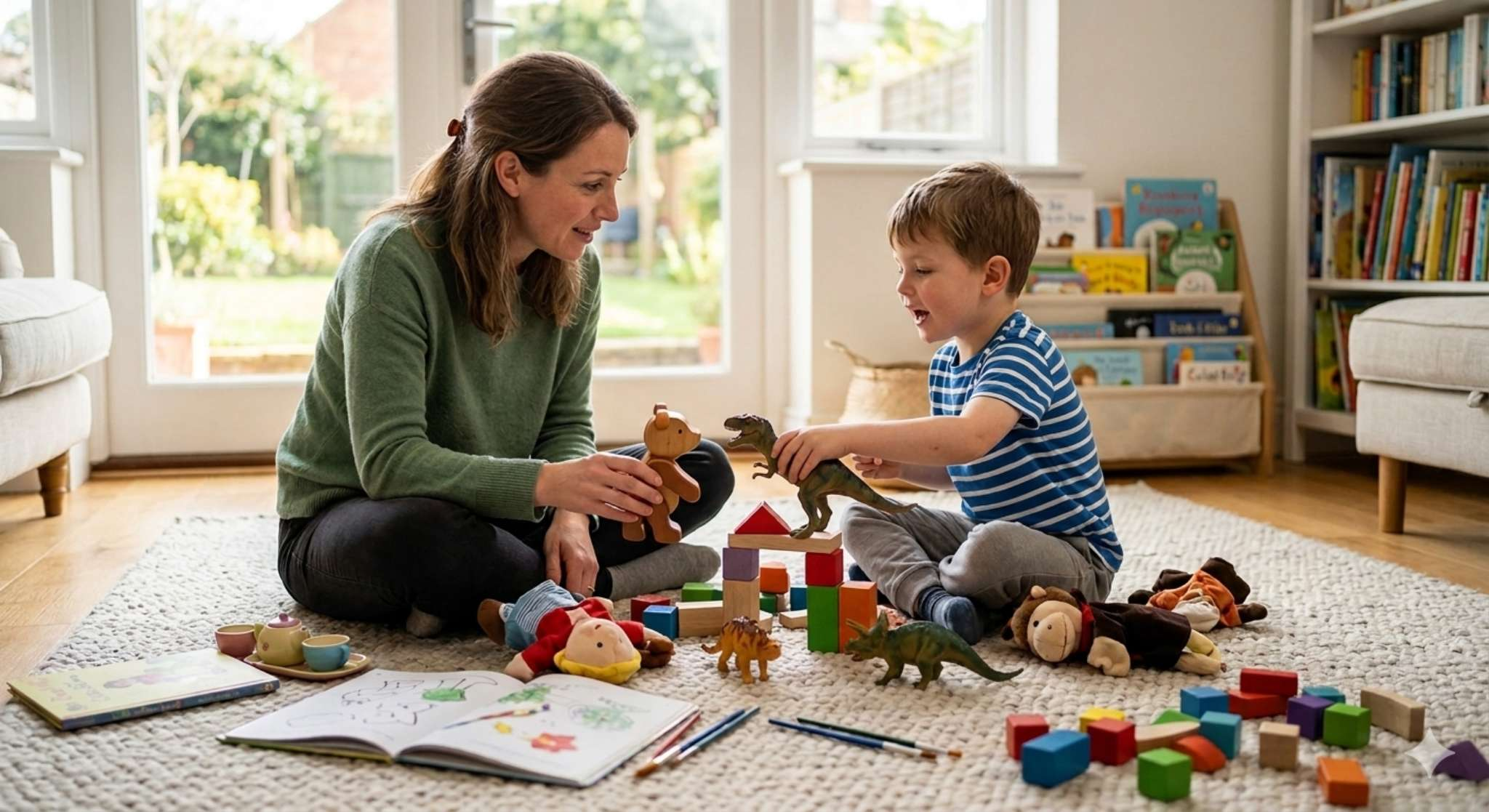
Understanding play as the natural language of the child’s inner world
Looking at Play with Adult Eyes
For many adults, play can seem like a pleasant but secondary activity. Something children do when homework is finished. A break between “real” tasks. A reward. A pastime. A way to pass time.
But from a developmental and psychological perspective, play is not a luxury. It is not a distraction. It is not simply entertainment.
Play is the primary medium through which children think, feel, learn, relate, and heal.
When adults see play only as recreation, they miss one of the most powerful processes shaping a child’s emotional and psychological development.
Play as the Child’s Language
Children do not experience the world in the abstract, verbal, conceptual ways adults do. Their understanding of life emerges through sensory experiences, imagination, movement, and relational interaction. Their emotional life is expressed in images, actions, and stories long before it can be described in words.
Play is the child’s language.
A child who lines up toys, repeats scenes, builds and knocks down structures, or creates imaginary worlds is not simply “playing.” They are communicating with themselves and with others about their inner experience.
In play, children show what they cannot yet explain.
Play as Emotional Processing
Emotional experiences do not disappear simply because they are not spoken about. They remain active in the child’s body and nervous system. Play provides a natural way for these experiences to be processed.
A child who plays “doctor” after a medical procedure may be working to regain a sense of control over a frightening experience. A child who repeatedly stages stories about separation and reunion may be exploring fears of abandonment. A child who enacts battles may be expressing internal conflict, frustration, or attempts to manage feelings of powerlessness.
Through play, children move from emotional chaos toward emotional mastery. They replay situations in symbolic form, but this time with greater control, imagination, and flexibility. What was overwhelming becomes manageable.
Play and Emotional Regulation
Play does not only express emotions; it also helps regulate them. In playful states, children move fluidly between excitement and calm, frustration and pleasure. They practice entering and exiting emotional states within a safe framework.
This process strengthens the nervous system’s capacity to tolerate feelings. Emotional intensity becomes less threatening because it is experienced in manageable doses, embedded in a context of safety and connection.
When play is shared with an attuned adult, this regulatory function becomes even stronger. The adult’s presence provides emotional containment, making exploration possible without overwhelm.
The Role of Imagination
Imagination is a central element of play and a crucial tool in emotional development. Through imagination, children create symbolic representations of their experiences. Symbols allow difficult emotions to be held at a distance that feels safer. A monster in a story can represent fear. A hero can represent courage. A broken object can symbolize loss.
Symbolic play helps children bridge the gap between raw feeling and understanding. It is a pathway toward meaning-making.
This capacity to symbolize is foundational not only in childhood but throughout life. It underlies creativity, empathy, problem-solving, and psychological resilience.
The Importance of Playful Relationships
When parents or caregivers join a child in play, they enter the child’s emotional world. By following the child’s lead, rather than directing the play, adults communicate acceptance and interest. The child experiences being met, not managed.
In these moments, the relationship deepens. The child feels seen not only in behaviour but in imagination. This strengthens attachment and supports emotional security.
Playful interactions also allow parents to model flexibility, joy, and emotional range. Through shared laughter, pretend stories, and imaginative exploration, the relationship becomes a space where emotions can be expressed safely.
What Happens When Play Is Reduced
In many modern contexts, children’s playtime is increasingly replaced by structured activities, academic demands, or passive screen consumption. While these have their place, a reduction in open, imaginative play can limit opportunities for emotional processing.
Without play, emotions may have fewer natural pathways for expression. Feelings may become bottled up, emerging later as anxiety, irritability, or behavioural challenges. Play deprivation can contribute to emotional rigidity and decreased resilience.
Play as Developmental Nutrition
Just as the body requires food to grow, the emotional system requires play. Play nourishes imagination, regulation, social understanding, and psychological flexibility. It supports the development of empathy as children experiment with roles and perspectives. It fosters problem-solving and creativity.
Play teaches children that inner experiences can be explored, not feared. That feelings can move. That challenges can be transformed.
Seeing Play Differently
When adults begin to see play as essential rather than optional, their approach shifts. Playtime is no longer something to be rushed through or used only as a reward. It becomes a meaningful part of relational life.
Parents do not need to entertain constantly or perform. They simply need to be present, curious, and willing to enter the child’s imaginative world.
In doing so, they support not only joy, but emotional growth.
Conclusion
Play is the child’s natural pathway toward emotional understanding. It is where feelings are expressed, processed, regulated, and integrated. It is where imagination meets experience, and where relationship becomes a container for growth.
In the world of a child, play is serious work. And in that work, emotional development unfolds.
Comments are closed